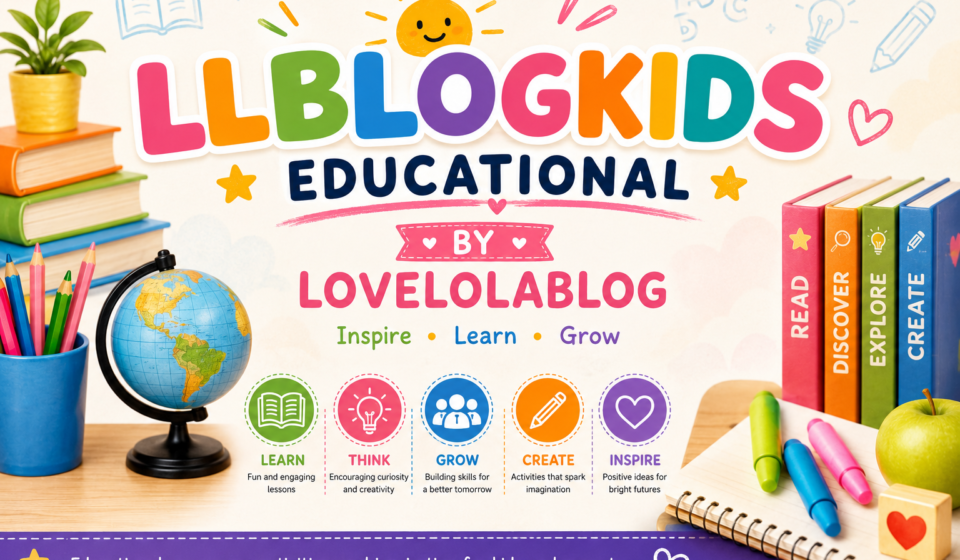

LLBlogKids Educational by LoveLolaBlog: A Complete Guide to Creative Learning for Children
Parents today have more educational resources available than ever before, but finding content that is both engaging and meaningful can still be challenging. Many learning platforms focus heavily on worksheets or screen time, while others overlook creativity and practical experiences. This is where LLBlogKids educational by LoveLolaBlog stands out as an inspiring concept for families seeking balanced, enjoyable, and effective learning opportunities.
Rather than treating education as a series of lessons to complete, this approach encourages children to explore, experiment, create, and discover through everyday experiences. It combines educational activities with imagination, hands-on projects, reading, science, art, outdoor exploration, and family interaction to make learning feel natural instead of forced.
This comprehensive guide explores what LLBlogKids educational by LoveLolaBlog represents, its educational philosophy, learning benefits, practical activities, and how parents can incorporate similar ideas into their daily routines to support lifelong learning.
What Is LLBlogKids Educational by LoveLolaBlog?
LLBlogKids educational by LoveLolaBlog refers to educational content designed to make learning enjoyable, creative, and family-friendly. Instead of relying solely on textbooks or classroom instruction, it encourages children to learn through exploration, curiosity, and everyday experiences.
Its focus includes:
- Hands-on learning
- Creative play
- STEM activities
- Reading development
- Arts and crafts
- Family learning projects
- Outdoor exploration
- Life skills
- Critical thinking
- Emotional development
The goal is to help children become confident learners while strengthening family involvement in education.
Featured Snippet: What Is LLBlogKids Educational by LoveLolaBlog?
LLBlogKids educational by LoveLolaBlog is a child-focused educational approach that promotes creative, hands-on learning through crafts, reading, science experiments, outdoor activities, problem-solving, and family participation. It aims to make education engaging while supporting children’s cognitive, social, and emotional development.
Why Creative Learning Matters
Research consistently shows that children retain information more effectively when they actively participate in learning rather than simply memorizing facts.
Creative educational activities help children:
- Improve memory
- Develop communication skills
- Build confidence
- Encourage curiosity
- Strengthen imagination
- Enhance decision-making
- Improve concentration
- Learn through experimentation
These benefits extend well beyond academics and prepare children for real-world challenges.
Core Principles Behind LLBlogKids Educational by LoveLolaBlog
Learning Through Play
Children naturally learn while playing. Building blocks, pretend play, puzzles, and storytelling all contribute to important developmental milestones.
Play supports:
- Language development
- Logical reasoning
- Creativity
- Social interaction
- Emotional regulation
Rather than separating play from education, this approach combines both.
Hands-On Experiences
Children often understand concepts better when they can touch, build, and experiment.
Examples include:
- Growing plants
- Cooking together
- Measuring ingredients
- Building simple models
- Creating art projects
- Conducting science experiments
Hands-on experiences improve long-term understanding.
Encouraging Curiosity
Instead of immediately giving answers, parents can ask questions such as:
- Why do you think that happened?
- What would happen if we changed this?
- Can you think of another solution?
- How could we improve it?
These conversations build analytical thinking.
Benefits of LLBlogKids Educational by LoveLolaBlog
Stronger Problem-Solving Skills
Activities that require planning and experimentation teach children how to solve problems independently.
Examples include:
- Building towers
- Completing puzzles
- Coding games
- Treasure hunts
- Engineering challenges
Better Communication
Interactive activities encourage children to:
- Express ideas
- Ask questions
- Listen carefully
- Explain solutions
- Share discoveries
Communication improves naturally through participation.
Increased Confidence
Completing projects successfully helps children believe in their own abilities.
Confidence grows when children:
- Finish a craft
- Read independently
- Complete experiments
- Learn new skills
- Solve challenges
Positive reinforcement further strengthens self-esteem.
Greater Love for Learning
When education feels enjoyable instead of stressful, children become naturally motivated to continue learning.
Intrinsic motivation leads to:
- Better academic performance
- Increased curiosity
- Lifelong learning habits
Educational Activities Families Can Try
Reading Adventures
Reading remains one of the most valuable educational activities.
Ideas include:
- Family reading nights
- Picture book discussions
- Character drawing
- Story sequencing
- Vocabulary games
- Reading journals
These activities improve literacy while making books exciting.
Science Experiments
Simple experiments encourage observation and inquiry.
Examples:
- Baking soda volcano
- Rainbow milk
- Floating egg experiment
- Homemade slime
- Seed germination
- Water cycle demonstration
Science becomes memorable through participation.
Creative Arts and Crafts
Art develops imagination while improving fine motor skills.
Projects may include:
- Paper animals
- Nature collages
- Painting
- Clay modeling
- Card making
- Recycled crafts
There are no perfect outcomes—creativity matters more than perfection.
Outdoor Learning
Nature provides endless educational opportunities.
Activities include:
- Leaf identification
- Bird watching
- Nature scavenger hunts
- Gardening
- Weather observations
- Rock collection
Outdoor experiences also improve physical health.
STEM Learning for Young Children
STEM combines Science, Technology, Engineering, and Mathematics into interactive experiences.
Ideas include:
Engineering Challenges
Children can build:
- Bridges
- Towers
- Marble runs
- Paper airplanes
- Popsicle-stick structures
Math Games
Learning math through games makes it less intimidating.
Examples:
- Counting scavenger hunts
- Dice games
- Shape hunts
- Measuring objects
- Cooking measurements
- Money activities
Beginner Coding
Many age-appropriate coding games introduce:
- Sequencing
- Logic
- Patterns
- Algorithms
- Computational thinking
Coding encourages structured problem-solving.
Developing Life Skills
Education extends beyond academics.
Children also benefit from learning practical life skills.
Important examples include:
- Organizing toys
- Cleaning up
- Setting the table
- Preparing snacks
- Time management
- Budgeting with allowance
- Following routines
- Caring for pets
These responsibilities build independence.
Supporting Emotional Intelligence
Children thrive when emotional development receives equal attention.
Parents can encourage:
- Naming emotions
- Gratitude activities
- Journaling
- Calm breathing
- Conflict resolution
- Kindness projects
Emotional intelligence improves relationships and resilience.
Screen Time and Digital Learning
Technology can support education when used intentionally.
Healthy digital learning includes:
- Interactive educational apps
- Digital drawing
- Educational documentaries
- Virtual museum tours
- Coding games
- Language-learning platforms
Balance remains essential.
Experts often recommend pairing screen-based learning with hands-on activities.
Creating an Educational Home Environment
Learning doesn’t require expensive equipment.
Simple changes make a big difference.
Consider including:
- A reading corner
- Art supplies
- Building blocks
- Educational puzzles
- Whiteboards
- Maps
- Science kits
- Musical instruments
Easy access encourages spontaneous learning.
Daily Learning Routine Example
Parents can create a flexible schedule that avoids pressure.
Morning:
- Reading
- Journaling
- Math games
Afternoon:
- Outdoor exploration
- Science activity
- Creative craft
Evening:
- Family discussion
- Storytelling
- Reflection on the day’s discoveries
Short, consistent sessions are often more effective than lengthy lessons.
Educational Ideas for Different Age Groups
Preschool (Ages 3–5)
Focus on:
- Colors
- Shapes
- Counting
- Storytelling
- Sensory play
- Music
- Movement
Elementary School (Ages 6–10)
Introduce:
- Reading comprehension
- Science experiments
- Writing stories
- Geography
- Math games
- Creative projects
Older Children (Ages 11–13)
Encourage:
- Independent research
- Coding
- Robotics
- Debate
- Creative writing
- Financial literacy
- Leadership activities
Activities should grow with children’s interests and abilities.
Common Mistakes Parents Should Avoid
Even well-intentioned educational efforts can become less effective when certain habits develop.
Avoid these common mistakes:
- Turning every activity into a lesson
- Comparing children with others
- Expecting perfection
- Overscheduling
- Ignoring children’s interests
- Relying entirely on screens
- Focusing only on grades
- Forgetting free play
Children learn best when curiosity leads the process.
How Parents Can Stay Involved
Parental involvement significantly influences children’s educational success.
Helpful strategies include:
- Reading together daily
- Asking open-ended questions
- Celebrating effort
- Exploring museums
- Visiting libraries
- Cooking together
- Encouraging creativity
- Listening carefully
Simple interactions often create lasting educational value.
Long-Term Benefits
Educational experiences inspired by LLBlogKids educational by LoveLolaBlog contribute to lifelong development.
Children may develop:
- Better communication
- Stronger creativity
- Higher confidence
- Improved academic performance
- Independent thinking
- Greater adaptability
- Stronger family relationships
- Continuous curiosity
These qualities support success throughout school and adulthood.
Frequently Asked Questions
What is LLBlogKids educational by LoveLolaBlog?
It is an educational approach centered on creative, hands-on learning experiences that combine reading, science, arts, life skills, and family involvement to help children develop academically and personally.
Is this approach suitable for homeschooling?
Yes. Many of the activities work well in homeschooling environments because they encourage active participation, exploration, and flexible learning schedules.
Can parents use these ideas without spending much money?
Absolutely. Everyday household items, recycled materials, books from local libraries, and outdoor spaces provide countless opportunities for meaningful educational experiences.
What age group benefits the most?
The ideas can be adapted for preschoolers, elementary-aged children, and even older learners by adjusting the complexity of activities to match developmental stages.
Why is hands-on learning important?
Hands-on learning helps children understand concepts more deeply by allowing them to experiment, observe, solve problems, and remember information through direct experience.
How often should educational activities be planned?
Consistency matters more than duration. Even 20–30 minutes of engaging learning activities each day can support healthy cognitive and emotional development while keeping children motivated.
Conclusion
LLBlogKids educational by LoveLolaBlog reflects a modern approach to childhood learning that values curiosity, creativity, and meaningful family involvement. Rather than relying solely on traditional instruction, it encourages children to discover new ideas through reading, science, art, outdoor exploration, practical life skills, and imaginative play.
By creating engaging learning opportunities at home, parents can help children develop confidence, critical thinking, communication skills, and a genuine love for learning that extends far beyond the classroom. Whether through simple craft projects, family reading sessions, hands-on experiments, or nature adventures, every shared experience contributes to a richer educational journey.
Ultimately, the greatest lesson is that learning doesn’t have to be limited to school hours. With the right environment and encouragement, every day offers new opportunities for children to grow, explore, and build the skills they’ll carry throughout life.